Introduction
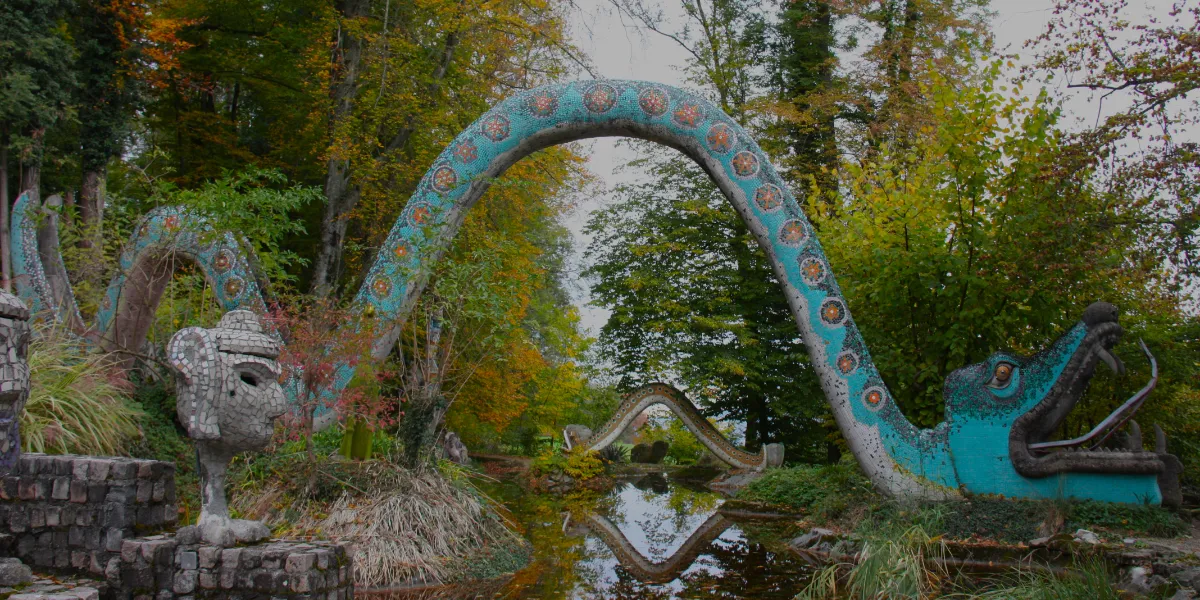
The Bruno Weber Park in Dietikon is one of Switzerland's most fascinating art projects. Spanning approximately 15,000 m², the artist Bruno Weber, together with his wife Maria Anna Weber, created a walk-in total work of art over four decades, blending sculptures, architecture, and nature into a mystical dreamworld.
With its monumental figures, structures, and hidden details, the park invites visitors of all ages to immerse themselves in another world - a world that oscillates between fairy tales, mythology, and modern art.
Since 2025, the park has been protected by both the Förderverein Bruno Weber Park (Support Association) and the Stiftung Bruno-Weber-Gesamtkunstwerk (Foundation), and is operated as a sculpture park that preserves Bruno Weber's artistic legacy and makes it accessible to the public.
Park Map (Tour)

What Makes the Park Unique
The Bruno Weber Park is more than a sculpture park - it is a walk-in work of art that appeals to all senses. Here are the features that distinguish it from other art sites:
A Walk-in Gesamtkunstwerk
Unlike classic sculpture parks, the Bruno Weber Park is a total work of art (Gesamtkunstwerk) in which architecture, sculptures, and landscape form an inseparable unity.
About the Artist
Bruno Weber was a painter, graphic artist, sculptor, inventor, carpenter, mason, plasterer, and architect, and... a visionary.
Over half a century, he created an absolute artwork that is unique in Switzerland.
Diversity of Sculptures
The sculptures in the Bruno Weber Park are made of various materials: concrete, stone, and fiberglass composite. There are monumental figures as well as tiny, hidden details that only become visible at second glance.
Integration of Nature
The artworks literally grow out of the ground - Bruno Weber designed his park in such a way that nature and art reinforce and transform each other.
Hidden Meanings
Many works carry symbolic messages - ranging from mythological allusions to the artist's personal views on life.
A Living Park
The park is constantly changing - through weathering, new vegetation, and active preservation efforts to protect Bruno Weber's original vision.
Placing Bruno Weber's Work in Art History
Bruno Weber passed away on October 24, 2011, at the age of 80, in peace and at ease. His work endures. Bruno Weber's work defies clear stylistic classification. It combines elements of various art movements to create something entirely unique.
At times, Bruno Weber's work is attributed to the Fantastic Realism art movement, which was also associated with artists like Friedensreich Hundertwasser. Yet Weber's art remains hard to categorize. Cultural editor Peter K. Wehrli once said: "Bruno Weber drew from the world's repository and made it his own." And art critic Fritz Billeter wrote: "With his total work of art, Bruno Weber built a world of richness and abundance. The luxury in his art manifests as the wealth of his imagination. It is limitless."
His sculptures are sometimes compared to the architectural creations of Antoni Gaudí. However, he only became acquainted with Gaudí's work after he had already built his first mosaic sculptures, such as the Snake Bridge. Nonetheless, he immediately recognized a kindred spirit in Gaudí. The French-Swiss artist Niki de Saint Phalle, famous worldwide for her "Nanas," wrote in one of her books that she was inspired by the Bruno Weber Park to build her own sculpture park, the Tarot Garden, in Tuscany.